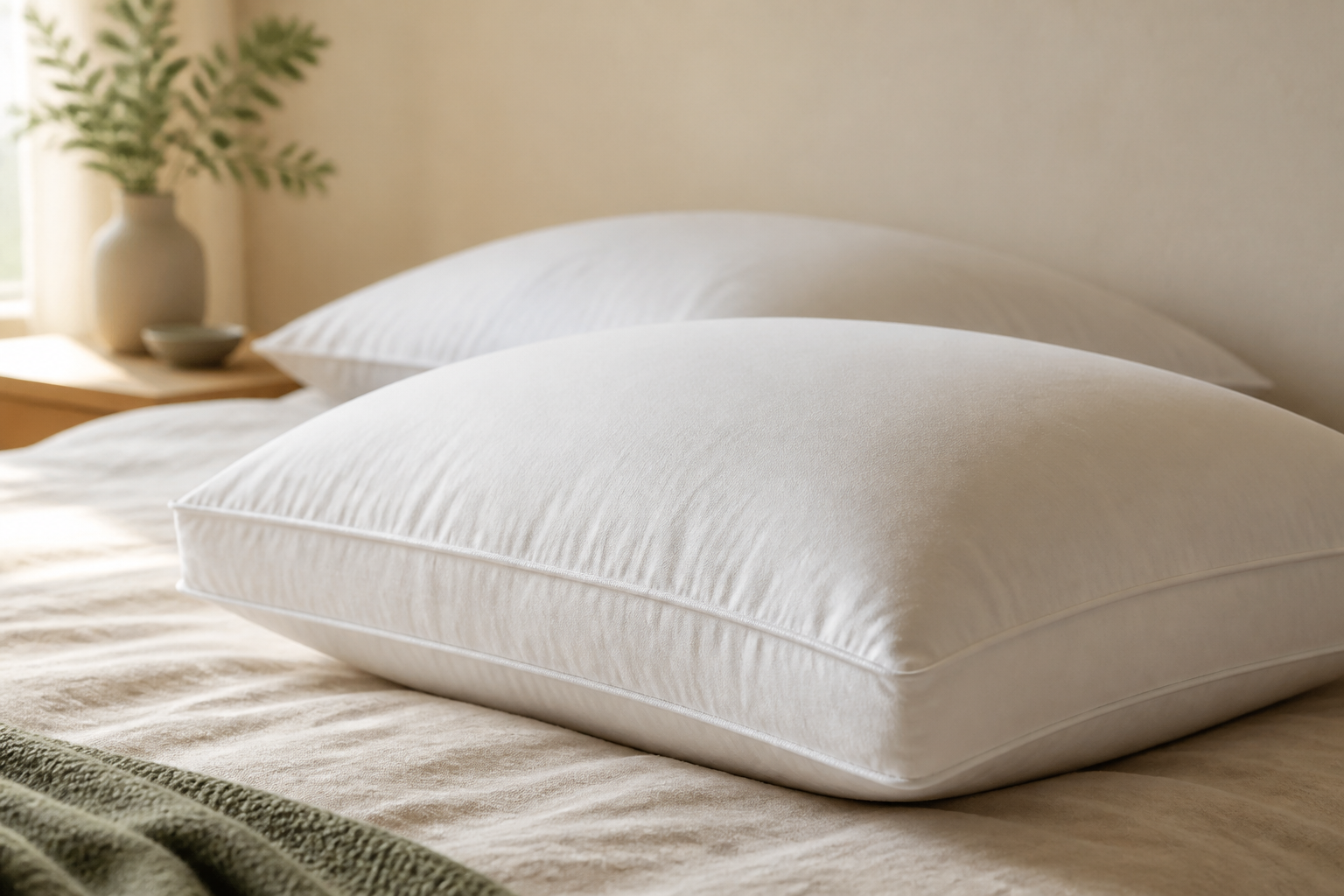
A gusseted pillow has a strip of fabric sewn between its top and bottom panels, creating a visible side wall instead of a single tapered edge. That extra panel gives the fill a more box-like chamber and can keep thickness more consistent toward the perimeter. It does not automatically make the pillow taller, firmer or better for your neck: fill amount, material and how far the pillow compresses under your head still decide the fit.
A gusset is only one construction detail, so use it alongside our complete pillow selection guide to compare fill, feel and sleep position.
If your main issue is the shoulder-to-mattress gap, start with the side-sleeper pillow guide rather than shopping by gusset depth alone.
Products to compare
4 products for different priorities
This is a verifiable shortlist, not a ranking based on hands-on testing. Amazon ratings and availability change, so always check the current listing.
Pillow-in-pillow adjustability
Casper Original Pillow
Casper lists a 2-inch gusset, an 18 x 26-inch Standard footprint, a removable inner pillow, cotton outer cover and polyester microfiber fill.
Multiple down density choices
The Company Store Legends Hotel Best Down Gusseted Pillow
The maker publishes a 2-inch gusset, 625 fill power, a 75% duck-down/25% feather blend, cotton-twill shell and soft, medium or firm choices.
A feather-filled two-inch-gusset example
Pacific Coast Diamond Pattern Gusseted Pillow
Pacific Coast describes a 2-inch gusset, goose-feather fill, a dual down-proof barrier and a 100% cotton cover.
A smaller one-inch synthetic gusset
Not sold on Amazon — check the brand directly.
Ella Jayne lists a 1-inch gusset, polyester microfiber shell, synthetic fiber fill, medium/slightly firm feel and machine-washable construction.
Not sold on Amazon — check the brand directly.
What does gusseted mean on a pillow?
On a conventional knife-edge pillow, the top and bottom fabric panels meet at one perimeter seam. A gusset adds a third piece: a continuous fabric band connecting those panels. Look from the side and you will see two perimeter seams with a vertical panel between them. Piping is different—it is the narrow cord finishing a seam and can appear on either construction.
The side wall creates more usable volume near the edge, so a filled pillow can look squarer and stay less tapered from center to perimeter. The gusset itself is not the support material. A loosely filled two-inch-gusset pillow can compress lower than a well-filled knife-edge pillow, and two models with the same gusset can feel completely different.
What is the advantage of a gusseted pillow?
The practical advantage is shape control. By separating the upper and lower panels, the side wall gives fill space at the edges and can reduce the steep center-to-edge slope of a knife-edge design. That can be useful when you use more of the pillow surface or want a defined edge under the neck.
Treat that as a construction benefit, not a guaranteed sleep outcome. Casper, for example, publishes a two-inch gusset for its Original Pillow, but also uses a removable pillow-in-pillow design and microfiber fill. Pacific Coast pairs a two-inch gusset with feather fill. Their loaded feel will differ because the entire build—not the fabric band alone—controls compression.
- More defined, box-like perimeter
- More fill space toward the edges
- Easier to identify a published side-wall dimension
- No guarantee of firmness, durability or correct neck height
- Piping alone does not mean a pillow is gusseted
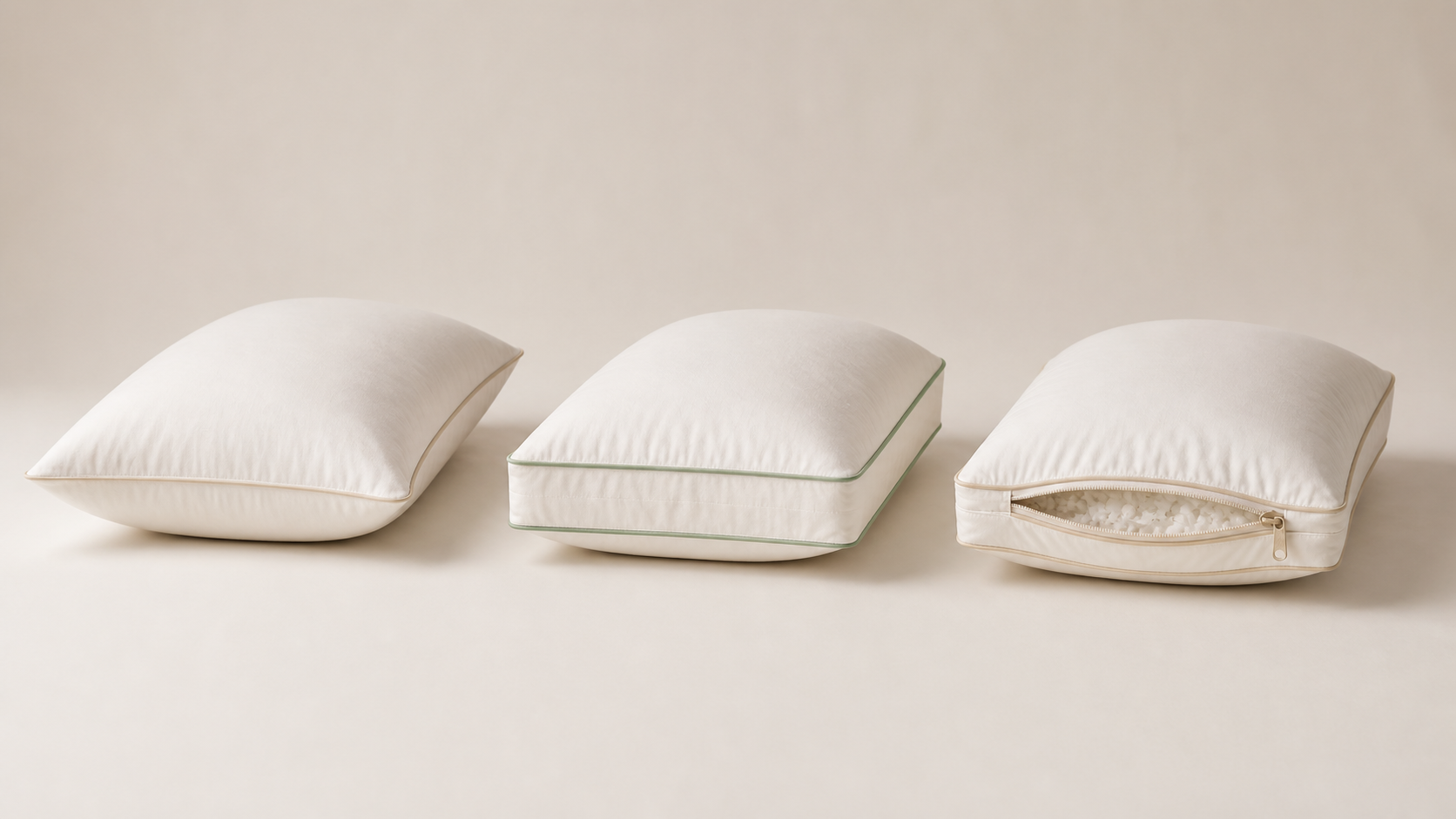
Are gusseted pillows better than regular pillows?
Not universally. Choose the pillow that keeps your head comfortable in your normal position after the fill is loaded. Side sleepers often need more usable height than stomach sleepers, but mattress sink, shoulder width, body size and fill compression all change the required loft. A gusset may help maintain edge volume; it cannot tell you whether that volume is right for you.
A concrete comparison: a stomach sleeper may prefer a soft knife-edge down pillow that spreads easily. A side sleeper who uses the full width could prefer a firmly filled gusseted model. A combination sleeper may value adjustable fill more than either seam style. If you are choosing down or feather, compare density and fill specifications in our down-pillow guide as well.
Want to feel what a two-inch gusset does?
Check the current size, seller and return terms before ordering. The link opens Amazon through our tracked OneLink route.
Four current gusseted pillow examples
Casper Original is the clearest hybrid-construction example: a two-inch gusset, removable inner pillow, cotton outer cover and polyester microfiber fill. The Company Store Legends Hotel Best Down Premium shows how the same two-inch side-wall idea works with 625-fill-power duck down and feathers, in soft, medium and firm densities.
Pacific Coast's Diamond Pattern model is a feather example with a published two-inch gusset. Ella Jayne's Luxury Plush uses a smaller one-inch gusset, microfiber shell and synthetic fiber fill. These are specification-based examples, not hands-on winners. The useful comparison is two inches versus one, natural versus synthetic fill, and fixed versus removable inner construction—not an unstable marketplace star score.
How to check gusset depth, loaded loft and case fit
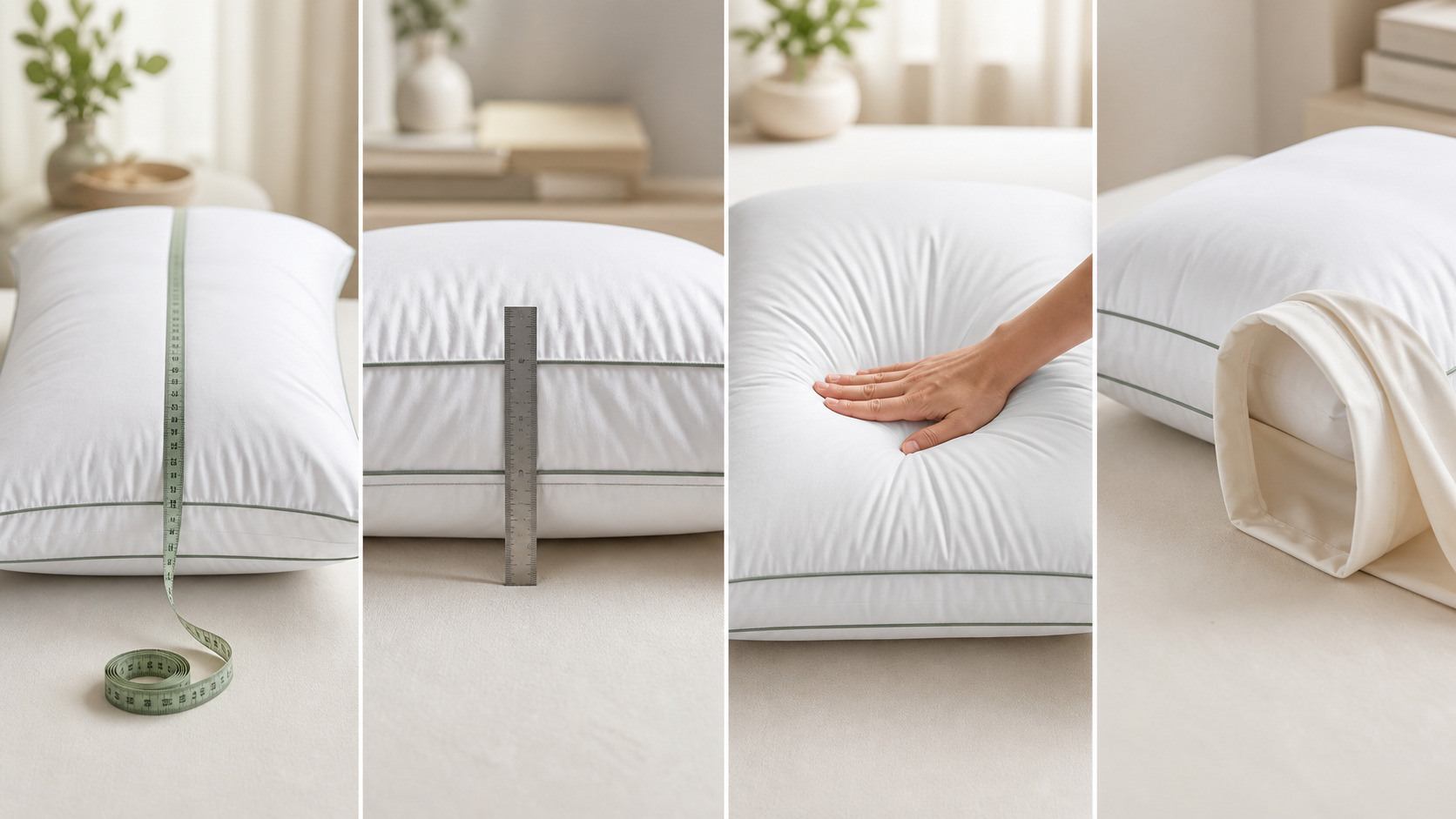
First confirm that the quoted measurement is the side-panel depth, not the pillow's uncompressed center height. Then place the pillow on your mattress, lie in your normal position and let it settle. Loaded loft—the height under your head—is more useful than catalog height. If your head is pushed up or drops toward the mattress, the gusset label does not rescue the fit.
Measure the pillow's finished width and length after fluffing and compare them with the case, using our standard pillow-size guide when needed. A tight case can squeeze a gusseted pillow into a firmer, taller shape; an oversized case can bunch. For example, Casper publishes an 18-by-26-inch Standard footprint, while Ella Jayne lists its Standard at 20 by 25 inches. The word Standard does not make those footprints identical.
Who should consider one—and who can skip it?
Consider a gusset when you want a defined edge, tend to move toward the side of the pillow or have already found that a boxier, evenly filled shape suits you. It is also a useful comparison feature when makers publish both gusset depth and fill details. Side sleepers may find that geometry promising, but should still judge compression in their own sleep position.
Skip the feature-first approach if you already sleep comfortably on a knife-edge pillow, need a very low and moldable surface, or cannot verify the loaded feel and return terms. Do not use a gusseted pillow as a treatment for persistent neck pain, numbness, weakness or sleep-breathing symptoms. Those concerns deserve appropriate clinical advice, not a seam-style claim.
Frequently asked questions
What is the advantage of a gusseted pillow?
The fabric side wall creates more fill space at the perimeter and can produce a boxier, more consistent edge. It does not by itself guarantee firmness, durability or the correct loaded loft.
Are gusseted pillows better for side sleepers?
They can be useful when a side sleeper needs usable edge volume, but the correct choice depends on loaded loft, fill, shoulder-to-mattress gap and mattress sink. A gusset is not automatically better.
Do I want a gusseted pillow?
Consider one if you prefer a defined edge or a squarer pillow shape. Compare the published gusset depth, fill, firmness options, actual footprint and return policy, then judge how far it compresses under your head.
Is piping the same as a pillow gusset?
No. Piping is a narrow cord or trim along a seam. A gusset is a separate fabric panel between the top and bottom faces, so it has two perimeter seams and measurable depth.
Sources
About the editorial team
The Pillow Advisor checks product specifications, care instructions and reliable expert sources. We do not invent hands-on testing or medical claims.