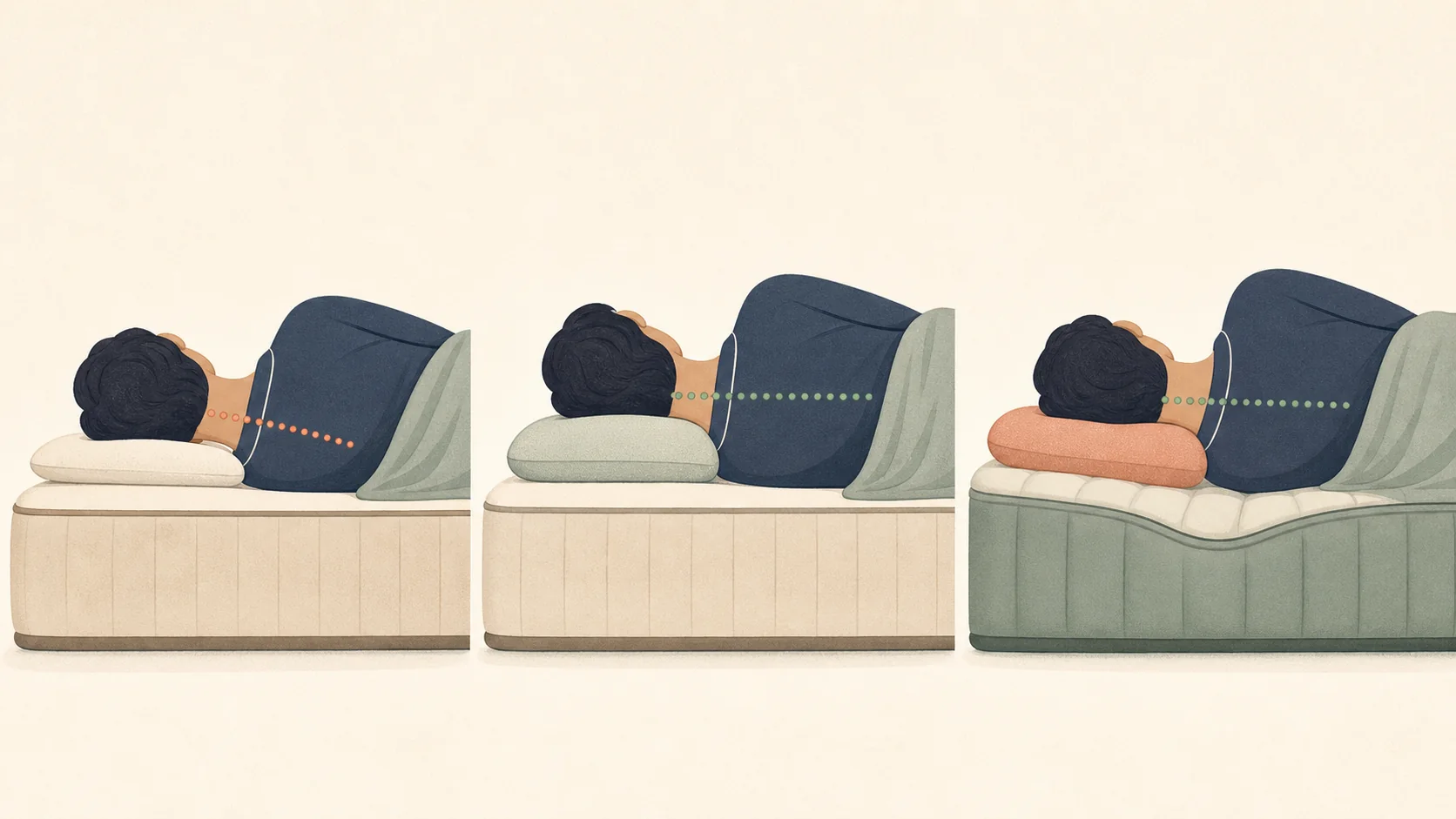
The Cube turns a side-sleeper measurement into a fixed block. Compare that approach with contoured, shredded and traditional choices in our side-sleeper pillow guide before relying on body height alone.
Important: Pillow Cube presents posture and pain-related benefits in marketing. This page evaluates fit mechanics and policies, not treatment efficacy or an individual medical condition.
Section 1
A cube is a fit hypothesis, not a cure
The Side Cube replaces a sloping or rounded pillow edge with a near-rectangular foam block intended to occupy the space between shoulder and head. That is a clear mechanical idea for strict side sleeping: if the height equals the loaded gap, the head can rest without the edge collapsing away.
The same geometry becomes a liability when the measurement is wrong. Too tall pushes the head upward; too short allows it to drop. A soft mattress lets the shoulder sink and usually reduces the required pillow height, while a firm mattress often leaves a larger gap. The product shape cannot automatically account for that difference.
Section 2
Separate Side Cube from Deluxe and Combo Cube
Pillow Cube's official support page lists the basic Side Cube at 12 × 24 × 5 inches and the Side Cube Deluxe at 14 × 28 inches in Thin 4, Regular 5 and Thick 6-inch profiles. Combo Cube is positioned for people who rotate between back and side. Names and variants matter because an old review of one model is not evidence for another.
The basic Cube's compact width can suit sleepers who remain in one area but offers less roaming space than a conventional queen pillow. Deluxe extends the sleeping surface. Check the selected product title, profile and included cover in the cart rather than assuming every 'Pillow Cube' listing is the adjustable three-height Deluxe.
Section 3
Sizing by body height is only a shortcut
The company guide associates 4 inches with shorter or narrow-shouldered people, 5 inches with average builds and 6 inches with taller or wider-shouldered people. That is easy to follow, but standing height is an indirect proxy for the actual side-lying gap.
Measure from the side of the neck toward the outer shoulder, then account for mattress compression and how much the foam itself yields. If between profiles, examine the current exchange process before ordering. A photograph from behind while lying normally can reveal head tilt better than judging comfort while propped on an elbow.
Section 4
Strict side sleepers are the clearest audience
Someone who sleeps nearly all night on one side and dislikes tapered pillow edges is the most logical candidate. The flat side can give the shoulder a defined boundary and the broad top prevents the head from rolling into a central crater. The foam's exact feel still needs personal evaluation.
Back-side combination sleepers may prefer the Combo Cube or a less abrupt contour. Stomach sleepers generally need much lower loft and should not treat this as an all-position product. People who hug, fold or scrunch their pillow may also find a solid rectangular core restrictive.
Section 5
Foam and cover care require model-specific labels
Solid foam should not be assumed machine-washable. Remove and clean only the cover or protector according to its sewn label and spot-clean the core if the manufacturer permits. Do not use high dryer heat, wring the foam or remake the bed around a damp core.
A fitted Cube cover preserves the rectangular profile better than forcing the pillow into a too-small conventional case. Include spare-cover availability in ownership cost, particularly for the less common depth and compact length.
Section 6
The US guarantee includes conditions and fees
Pillow Cube's current refund policy gives US orders a 60-night satisfaction guarantee and recommends trying the pillow for roughly three weeks. It states a return-shipping fee unless a separate Re:do service was purchased; original outbound shipping and Re:do are not refunded. Final-sale products are excluded.
The same policy says international orders are final sale except where applicable law, including EU withdrawal rights, requires otherwise. Exchanges outside the contiguous 48 states can carry additional charges. Read the exact regional terms before ordering and do not describe the guarantee as universally free.
Section 7
Warranty is not a comfort exchange
The official pillow warranty runs 24 months for eligible original purchasers and covers defined structural or workmanship defects, including specified cell deterioration, splitting or cracking under normal handling. It does not promise that the chosen profile will feel comfortable.
Keep proof that the seller was Pillow Cube or an authorized retailer. Use the return or size-exchange process for fit problems during its applicable window; use the warranty only for covered defects. A marketplace seller may apply separate return logistics while manufacturer warranty eligibility still depends on authorization.
Section 8
Verdict: excellent clarity, narrow margin for error
Pillow Cube deserves credit for stating exactly what problem its geometry addresses and offering distinct profiles in the Deluxe. It can be a strong fit for a committed side sleeper who measures carefully and wants a solid edge. It is riskier for mixed positions, uncertain loft needs or overseas purchases with limited returns.
We used current official dimensions, positioning, refund and warranty terms and did not conduct a hands-on sleep test. Choose the Cube only after pairing shoulder gap with mattress sink and confirming the seller's exchange path. An adjustable pillow is the safer experiment when you cannot estimate required loaded height.
Sources
Frequently asked questions
What Pillow Cube size should I get?
The company points narrow or shorter sleepers toward 4 inches, average builds toward 5 and wider or taller builds toward 6. Improve that estimate with actual shoulder gap and mattress sink.
Is Pillow Cube only for side sleepers?
Side Cube is specifically intended for side sleeping. The company points side/back combination sleepers toward Combo Cube; stomach sleepers usually need a different, lower profile.
Can you return a Pillow Cube?
Eligible US orders currently have a 60-night guarantee, but the policy lists fees and exclusions. International orders may be final sale except where applicable law provides rights.
How long is the Pillow Cube warranty?
The current pillow warranty is 24 months for defined defects and eligible original purchases. It does not cover choosing an uncomfortable height.