
For a side sleeper, a pillow between the knees can keep the top leg from dropping across the lower leg and can make the hips, pelvis, and spine feel more neutrally stacked. The useful part is not the product label; it is supporting enough of the top leg without forcing the knees too far apart. Start with a pillow you already own, test placement for several nights, and buy a specialty shape only when you know what slips, compresses, or feels too bulky.
When you know you want a compact foam spacer, compare our knee pillow picks by shape, size and cover care.
If you want support from chest to ankle rather than only at the knees, compare our body pillow guide before choosing a compact wedge.
Leg support does not correct a head pillow that is too high or low, so check it alongside our side-sleeper pillow guide.
Products to compare
4 products for different priorities
This is a verifiable shortlist, not a ranking based on hands-on testing. Amazon ratings and availability change, so always check the current listing.
Longer compact support
Contour Legacy Leg & Knee Pillow
Memory foam with a removable washable quilted cover; 10 x 9 x 6 inches, tapering to 2.75 inches. Its longer shape contacts more of the thighs than a small hourglass block.
Firm sculpted support
Not sold on Amazon — check the brand directly.
The maker lists 9.5 x 8.5 x 5.5 inches, dense memory foam, two sizes, and a removable washable cover; the foam core is not washable.
Not sold on Amazon — check the brand directly.
Simple hourglass trial
ComfiLife Orthopedic Knee Pillow
ComfiLife publishes a 3-inch curved knee area and a 100% polyester cover. The brand notes that fit differs across body types.
Knee-to-ankle and upper-body support
Coop Original Adjustable Body Pillow
A 20 x 54-inch adjustable body pillow with cross-cut memory foam and microfiber fill. It supports more of the top leg but occupies substantially more bed space.
Is it good to sleep with a pillow between your knees?
It can be a reasonable comfort and positioning option for side sleepers. Mayo Clinic advises drawing the legs slightly toward the chest and placing a pillow between them, explaining that this can help align the spine, pelvis, and hips. UCLA's ergonomics guidance likewise recommends support between the knees for side sleeping, with the top leg even with or slightly behind the bottom leg.
That does not make a knee pillow a treatment for every back, hip, pregnancy, circulation, or postoperative concern. If you have new severe pain, numbness, swelling, an injury, recent surgery, or instructions from a clinician, follow individualized medical advice. A retail pillow should not override movement restrictions or a prescribed recovery position.
Where exactly should the pillow go?
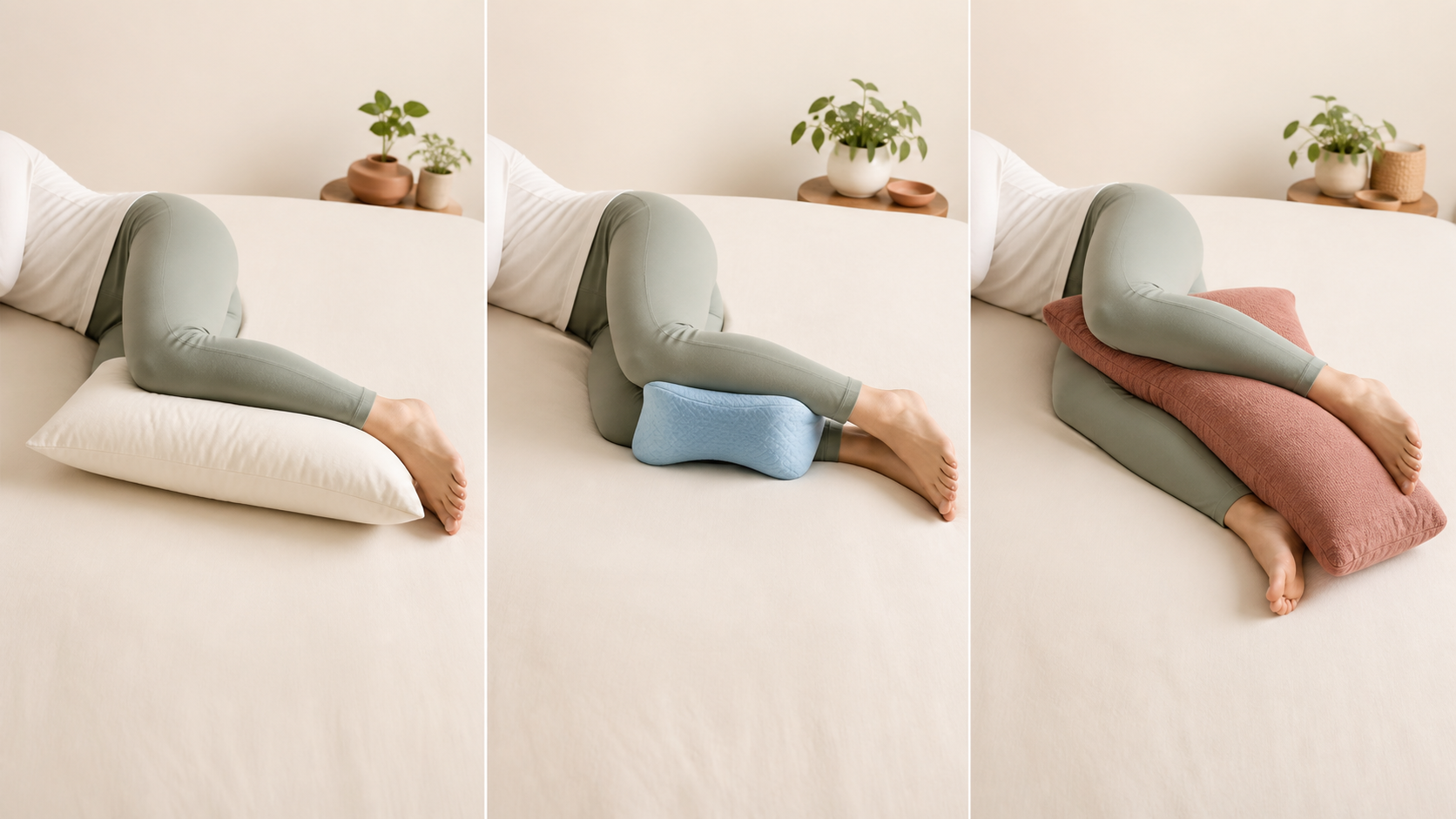
Place it between both knees and let it support the lower thighs as needed. Keep the top knee from falling far forward while the pelvis stays stacked. If the ankles knock together or the top lower leg hangs unsupported, try a longer pillow that reaches toward the ankles rather than adding more thickness only at the knee.
A useful test is to begin with a folded standard pillow. Lie on your usual side with both knees comfortably bent, place the pillow from just above the knees toward the shins, and remove folds until the hips feel level rather than pushed open. If the pillow migrates every time you turn, a contoured shape or strap may be more useful than a firmer block.
How thick should a knee pillow be?
There is no universal medical height. Body size, thigh shape, mattress sink, knee bend, and whether the pillow sits only at the knees or along the shin all change the effective gap. The correct thickness is the smallest amount that stops the top leg collapsing inward without lifting it uncomfortably.
For concrete scale, ComfiLife publishes a 3-inch dimension at the curved area where the knees touch. Cushion Lab lists a 5.5-inch overall height for its sculpted model, but the concave center means the usable separation is not the same as the outside height. Contour's Legacy tapers from 6 inches to 2.75 inches. Compare the channel where your legs rest, not just the largest product dimension.
Need a compact shape that supports more than the kneecaps?
Compare the channel depth, total length, cover care, retention, and current size before choosing.
Which shape fits which sleeper?
A regular bed pillow is the cheapest trial and can support both knees and ankles, but it may compress or occupy more bed space. An hourglass pillow is compact and cradles the knees, yet it may leave the ankles unsupported. A longer contoured leg pillow supports more of the thighs. A body pillow can support the upper arm, knee, shin, and ankle, although it is warmer and harder to move when turning.
Straps solve only one problem: retention. They can help an active sleeper keep a compact pillow attached while turning, but some people dislike fabric around the leg. Choose a removable, washable cover and check whether the foam core itself must remain dry. For a clearer full-length comparison, see our body pillow versus pregnancy pillow guide.
- Standard pillow: best low-cost fit test
- Compact hourglass: best when bed space is limited
- Long contoured leg pillow: best for broader thigh-to-knee contact
- Strapped model: best when a compact pillow repeatedly slips
- Body pillow: best when the knee, shin, ankle, and upper arm all need support
Four current examples and their honest trade-offs
Contour Legacy is the longer compact option: the maker lists memory foam, a removable washable quilted cover, and dimensions of 10 by 9 by 6 inches tapering to 2.75 inches. Cushion Lab is a firm sculpted option measuring 9.5 by 8.5 by 5.5 inches; its cover is washable but its foam core is not. ComfiLife is the simpler hourglass example with a published 3-inch knee channel and polyester cover.
Coop's Original Body Pillow takes the opposite approach. At 20 by 54 inches, it supports more of the body and has adjustable cross-cut memory-foam and microfiber fill. It needs far more bed space, and Coop recommends a commercial washer and dryer if the full body pillow is washed. These are manufacturer specifications, not our hands-on rankings; comfort and retention depend on your proportions and movement.
A three-night fit check before you keep it
Night one: use a standard pillow and note whether the knee, ankle, or both need separation. Night two: change only thickness by folding or removing a layer. Night three: note whether the problem is compression, heat, bed space, or slipping. That evidence tells you whether you need firmer foam, more length, a smaller shape, or a strap.
Stop using a setup that causes new pressure, tingling, numbness, swelling, or worse pain. Also reassess the head pillow and mattress: leg support cannot compensate for the torso rotating deeply into a sagging mattress or the neck being held at an angle. The goal is a comfortable, repeatable position—not forcing the body into a diagram.
Frequently asked questions
Is it good to sleep with a pillow between your knees?
It can be a useful positioning option for side sleepers. Mayo Clinic and UCLA describe it as a way to support alignment, but it is not a treatment for every pain condition or a substitute for postoperative or individualized medical instructions.
What is the best pillow to put between your knees?
Start with a standard pillow to learn the required thickness and support length. Choose a compact contour for limited space, a strap if slipping is the main issue, or a longer/body pillow when the shin and ankle also need support.
Why do people put a pillow between their legs?
Common reasons are to stop the top leg dropping forward, separate the knees, support a more stacked side-sleeping position, or simply improve comfort. The habit alone does not imply a medical condition.
Should a knee pillow support the ankles too?
Not always, but it can help when the ankles press together or the top lower leg feels as though it is hanging. In that case, try a longer standard or body pillow rather than making a compact knee pillow excessively thick.
Sources
About the editorial team
The Pillow Advisor checks product specifications, care instructions and reliable expert sources. We do not invent hands-on testing or medical claims.