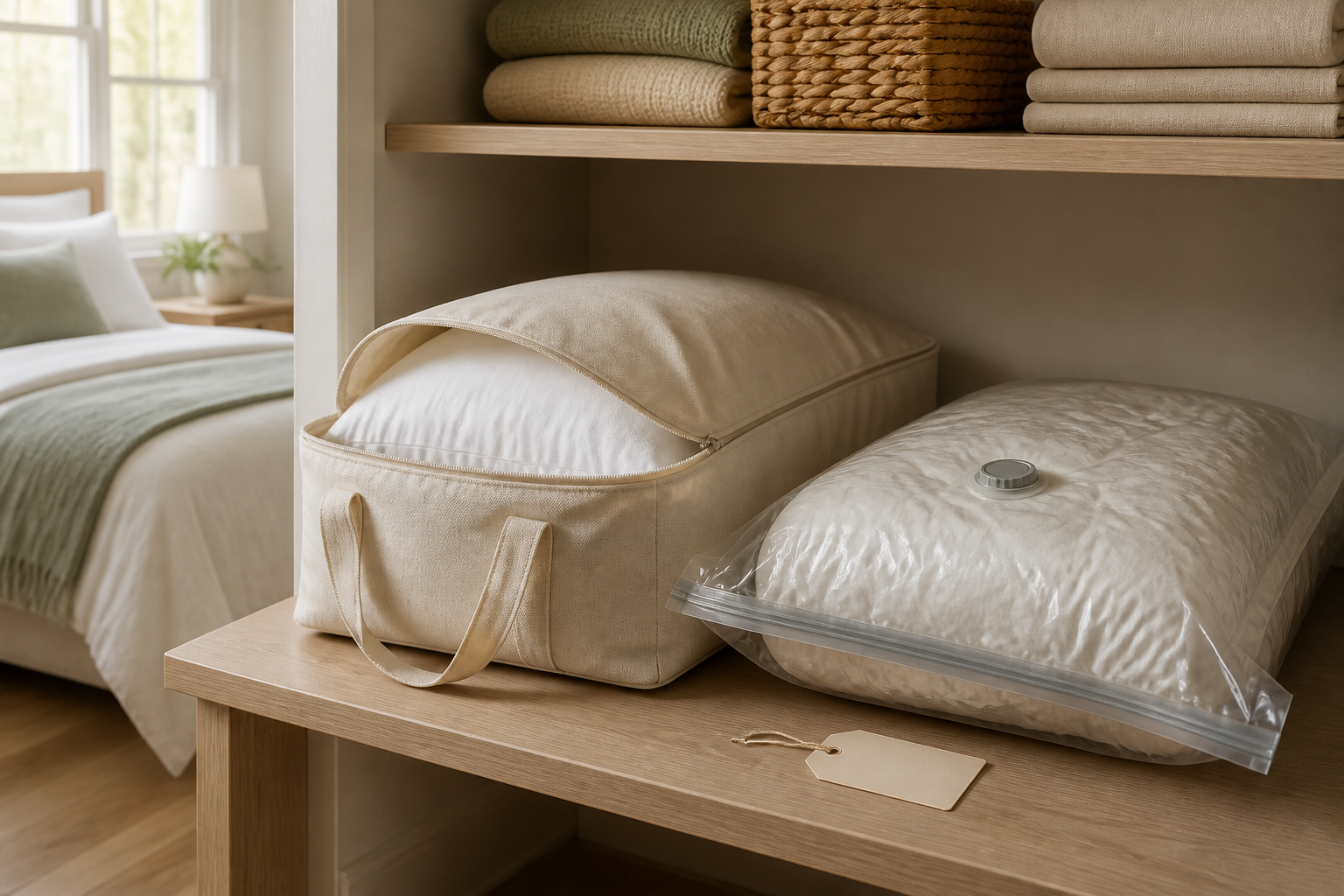
The best pillow storage bag is not automatically the one that removes the most air. Down and feather need room to stay lofted, solid foam should not remain tightly compressed, and every pillow must be completely clean and dry before it is enclosed. A vacuum bag can be useful for a short move or a resilient synthetic pillow, while breathable cotton or nonwoven fabric is usually the safer long-term starting point for natural fill. This guide matches the bag to the pillow rather than treating every bulky item alike.
A pillow that feels dry at the shell can still hold moisture in the center, so run our complete pillow drying check before storage.
If you see spotting or smell mustiness, use the mold-on-pillow decision guide instead of sealing the problem inside a bag.
Products to compare
4 products for different priorities
This is a verifiable shortlist, not a ranking based on hands-on testing. Amazon ratings and availability change, so always check the current listing.
Breathable storage for down and natural fill
Abode Living Pillow Storage Bag
A 100% cotton zip tote offered in standard (28 x 18 + 3 inches), king (34 x 18 + 3 inches) and euro (25 x 25 + 3 inches) sizes.
A fitted bag for one pillow
Down & Feather Company Pillow Travel Bag
A zippered polypropylene nonwoven bag with handles in standard, queen, king and euro pillow dimensions. It protects during storage or travel without vacuum compression.
Moving several synthetic pillows
VENO Heavy Duty Extra Large Moving Bags
The official 8-pack uses coated woven polypropylene, measures 29 x 12 x 14 inches per bag, provides 80 liters of space and is rated by the maker to carry up to 50 pounds.
Multiple sizes and short-term compression
Whitmor Spacemaker Reusable Vacuum Bags, 20-Piece Set
A 20-bag assortment from small 15 x 21-inch bags through a 35 x 51-inch jumbo bag, with airtight valves intended for clothing and bulky bedding.
Choose the bag from the pillow fill
For down, feather, wool or kapok, begin with a roomy breathable cotton or nonwoven bag. These fills rely on loft and can retain hidden moisture, so long-term airtight compression is a poor default. Down & Feather Company ships its pillows uncompressed in a handled travel bag, and Abode Living makes a cotton pillow bag specifically to let natural down breathe.
For polyester fiber, moderate short-term compression is usually less risky, but the care label still wins. For solid memory foam or latex, avoid assuming that a vacuum bag is safe. Tempur-Pedic says its TEMPUR-Cloud may be compressed for travel but should not be tightly compressed for an extended period; a different foam model may have different instructions.
- Down, feather, wool or kapok: roomy breathable bag
- Polyester fiber: fabric bag for long storage; moderate vacuum only when the label permits
- Solid memory foam: store flat or in its natural shape unless the maker says otherwise
- Molded latex: keep dry, cool, uncompressed and away from prolonged direct sun
- Adjustable shredded fill: secure every inner liner and store removed fill separately
Four useful pillow storage bag examples
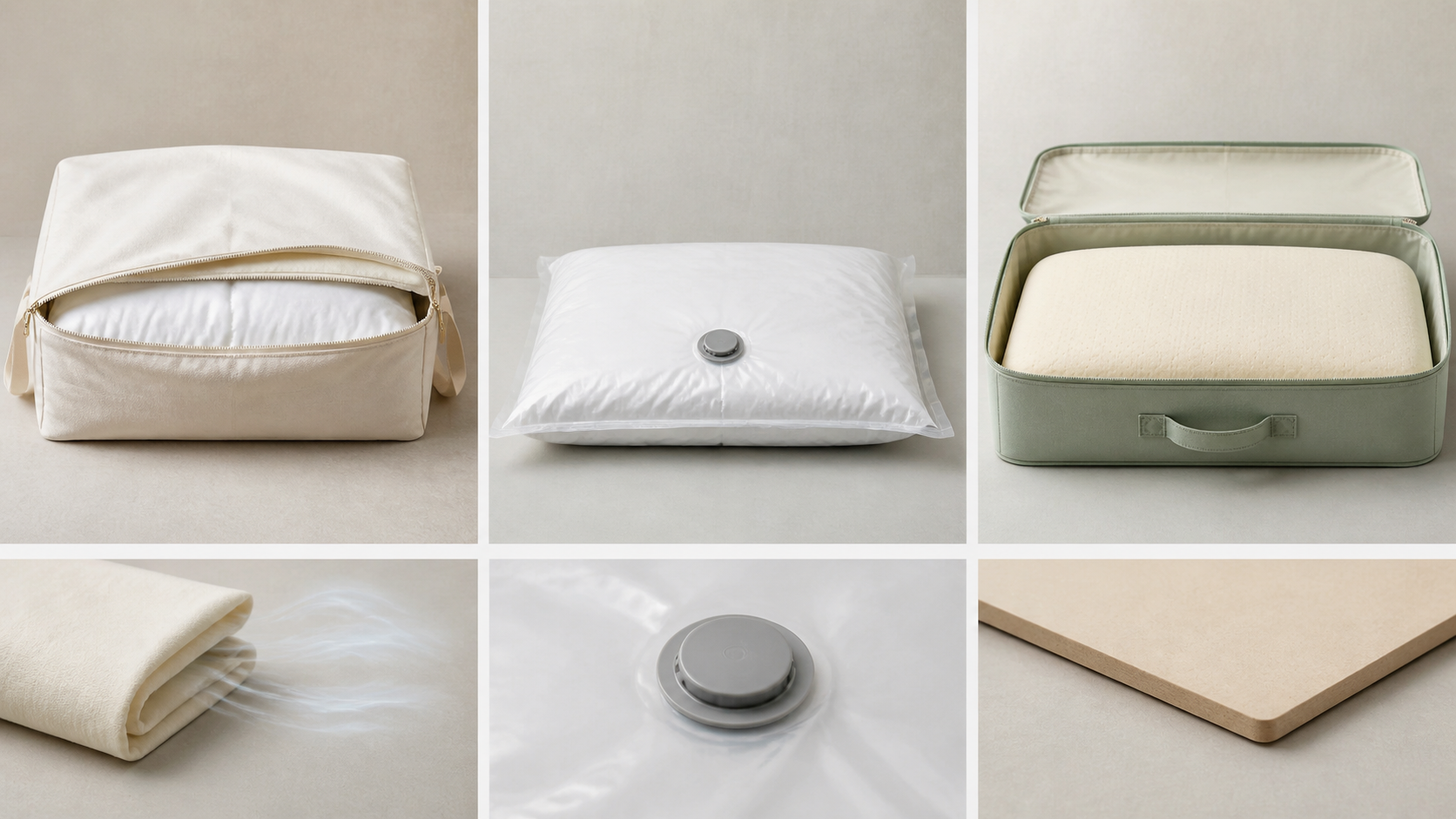
Abode Living is the purpose-built breathable option: 100% cotton in standard, king and euro sizes. Down & Feather Company's polypropylene nonwoven travel bag is sized to standard, queen, king and euro pillows and adds handles plus a zipper. VENO's coated woven moving tote is a transport-first choice; its official 8-pack model measures 29 by 12 by 14 inches, holds 80 liters and is rated by the maker for up to 50 pounds.
Whitmor's 20-piece Spacemaker set is the vacuum option. It ranges from 15 by 21 inches to 35 by 51 inches and is designed for bulky bedding. That variety is useful when you are packing synthetic guest pillows or moving, but the existence of a jumbo bag does not make extended vacuum compression appropriate for down, feather, latex or every foam pillow. These are specification-based examples, not hands-on test winners.
What is the best way to store spare pillows?
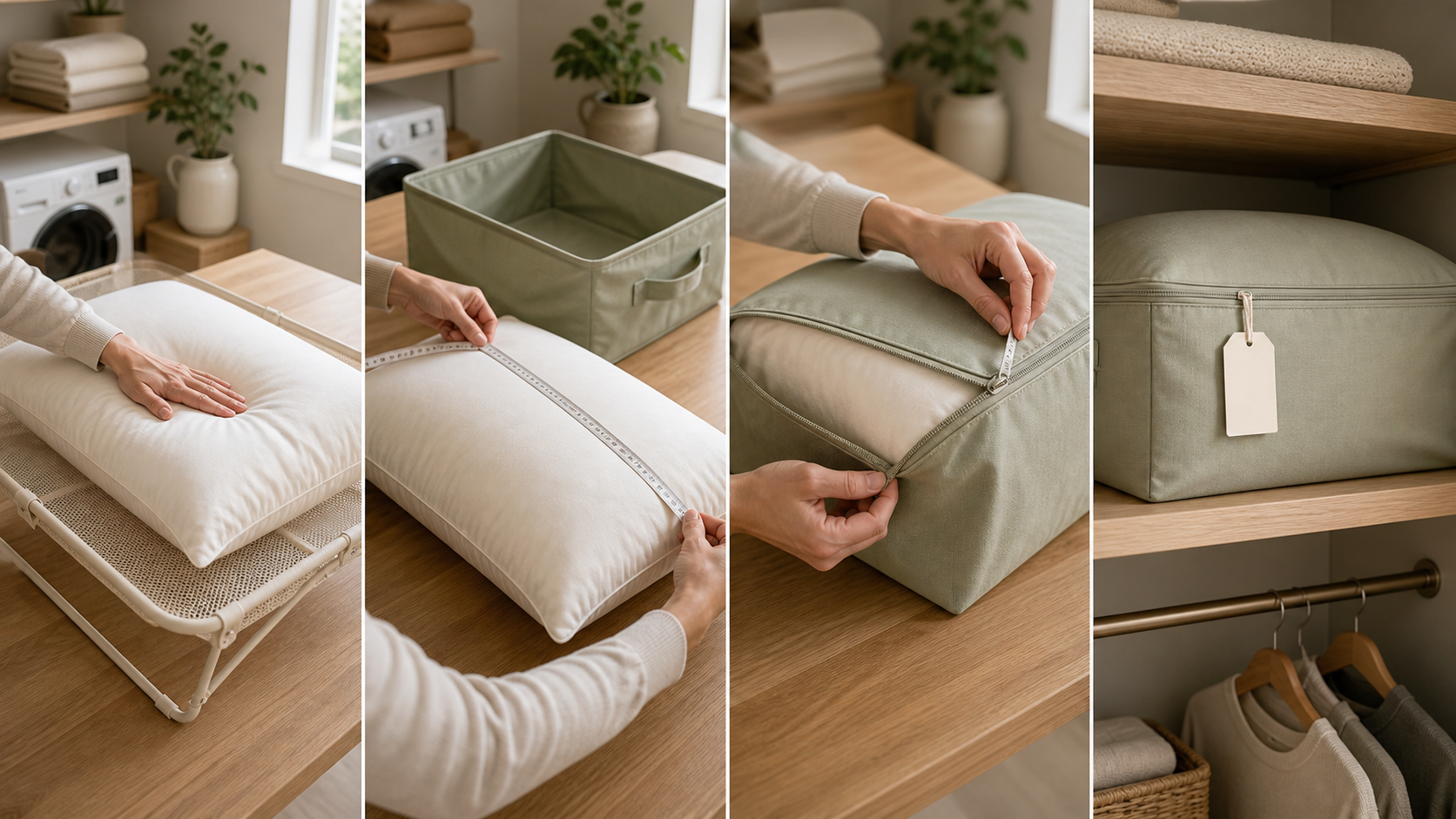
Clean only as the care label allows, then dry the pillow completely. Remove decorative cases, but keep any clean protector only if the pillow maker permits storage with it. Fluff fiber or down to distribute the fill, place the pillow in a correctly sized bag without forcing the zipper, and label the bag with fill type, size and storage date.
For example, two standard down guest pillows can sit side by side in a breathable cotton bedding bag on a dry closet shelf. A molded foam pillow should lie flat in a roomy case with nothing heavy stacked on it. A washable polyester pillow can go into a larger vacuum bag for a move, then should be released and allowed to regain shape promptly at the destination.
Need several vacuum-bag sizes for synthetic guest pillows?
Use vacuum storage only after the pillow is fully dry and its care instructions permit compression. Check the current seller and selected bag sizes before ordering.
Should pillows be stored in plastic bags?
Plastic is useful as a temporary barrier during a clean, dry move, but it also prevents airflow. Never seal a pillow that is damp, warm from a dryer or carrying an unexplained odor. Condensation, a tiny leak or residual core moisture can stay trapped even when the outside looks clean.
For seasonal storage, use the pillow manufacturer's instructions and the storage environment as the deciding factors. A breathable cotton or nonwoven bag on a dry indoor shelf protects against dust without creating the same sealed microclimate. A garage, attic or basement with large temperature swings, pests or high humidity is a poor location regardless of bag marketing claims.
Is it a good idea to store pillows in vacuum bags?
Vacuum bags save space, but compression is a material stress—not a neutral storage mode. Use one only when the pillow maker permits compression, and prefer short periods. Do not crush a pillow until the valve and seams strain; moderate compression is easier on the fill and the bag.
A concrete decision: a budget polyester guest pillow for a two-week move is a reasonable vacuum-bag candidate after it is fully dry. An expensive down pillow going into a closet for six months belongs uncompressed in a breathable bag. A solid foam contour pillow should retain its molded shape unless its own manufacturer explicitly describes a compression method.
A five-minute packing and unpacking check
Before closing the bag, press the pillow center and smell near—not inside—the opening. If it feels cool or damp, smells musty or was recently washed, return it to the drying step. Check the zipper path for loose feathers, fibers and fabric. Put the packed bag above the floor, away from an exterior wall, and do not stack a heavy box over foam or natural fill.
When unpacking, inspect the bag and pillow for moisture, odor, discoloration, torn foam or fill that does not recover. Air the pillow in a clean ventilated room and restore the protector and pillowcase only when everything is dry. If support does not return after label-approved fluffing or airing, compare condition with our pillow replacement checklist rather than repeatedly compressing it.
Frequently asked questions
What's the best way to store pillows?
Store them completely clean and dry, in a bag suited to the fill, on a dry indoor shelf. Natural fill usually needs a roomy breathable bag; solid foam should normally keep its shape; vacuum storage is best reserved for maker-approved, short-term compression.
What is the best way to store down pillows?
Keep down pillows uncompressed in a breathable cotton or nonwoven bag after they are completely dry. Do not place heavy items on top, and avoid damp basements, hot attics and long-term airtight plastic storage.
Should pillows be stored in plastic bags?
Plastic can protect a dry pillow during a short move, but it traps moisture and prevents airflow. For long seasonal storage, a breathable bag in a dry indoor location is the safer default unless the pillow maker specifies otherwise.
Is it a good idea to store pillows in vacuum bags?
Only for pillows whose manufacturer permits compression, preferably for short periods. Avoid prolonged tight compression of down, feather, molded latex and solid memory foam unless the exact care instructions allow it.
Sources
About the editorial team
The Pillow Advisor checks product specifications, care instructions and reliable expert sources. We do not invent hands-on testing or medical claims.