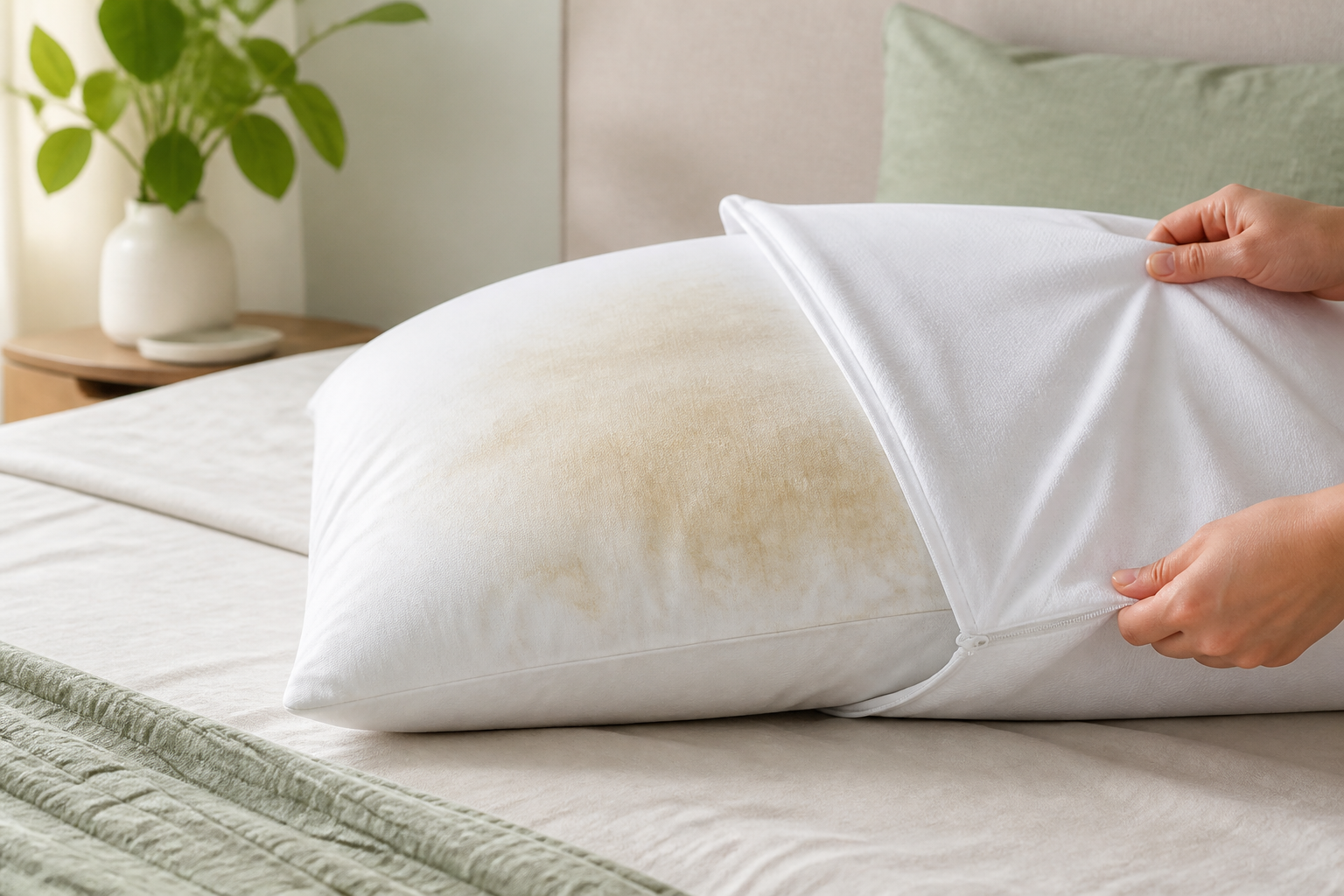
Pillows usually turn yellow because sweat, skin oils, saliva, damp hair, and skincare residue repeatedly reach the fabric and dry there. The color alone does not prove that a pillow is unsafe, but it does tell you that moisture and residue have accumulated. Before treating the stain, check the care label and identify whether you are looking at a washable cover, washable fiber fill, or a foam core that should stay dry.
Use the care label with our material-specific pillow washing guide before adding detergent, stain remover, water, or dryer heat.
If staining returns with persistent odor, damaged fill, or lost support, work through our pillow replacement checklist rather than judging by color alone.
Products to compare
3 products for different priorities
This is a verifiable shortlist, not a ranking based on hands-on testing. Amazon ratings and availability change, so always check the current listing.
Waterproof zippered barrier
SureGuard Waterproof Pillow Protectors
Cotton-terry surface over a waterproof barrier, with full zipper enclosure. Check the selected dimensions and current care instructions.
Full encasement with liquid barrier
Protect-A-Bed AllerZip Pillow Protector
Polyester encasement with polyurethane laminate and fine-tooth zipper. Follow the maker's specific wash and tumble-dry limits.
Lightweight allergen-focused barrier
Mission: Allergy Premium Microfiber Encasement
The maker publishes a 2-micron mean pore size, bound seams, zipper flaps, and microfiber construction. It is not positioned as a waterproof membrane.
Why yellow stains develop
A pillowcase slows transfer but does not form a sealed barrier. Night after night, moisture and residue can pass through the weave and reach the pillow shell. Sweat contributes water, salts, and other compounds; skin and hair add oil; saliva, wet hair, and products such as night cream add more moisture or residue. As those materials dry and age on light fabric, the affected area can appear cream, yellow, or brownish.
The pattern often gives a useful clue. A broad patch where the head rests points toward repeated sweat and oil transfer. A smaller mark near the mouth may be saliva. Staining that begins after sleeping with wet hair suggests water plus hair-product residue. None of these patterns identifies a medical condition, and one partner's pillow can discolor faster simply because habits, products, heat, and perspiration differ.
Is it okay to sleep on a yellow pillow?
Color by itself is not a reliable safety test. First check odor, dampness, visible growth, damaged fill, and whether the pillow still supports you. A dry pillow with an old cosmetic stain is a different case from a damp pillow with a persistent musty smell or spotting.
Stop using the pillow while you investigate if it remains damp, smells musty after drying, or shows suspicious fuzzy or spreading spots. Our guide to mold on a pillow explains why contamination inside porous fill is not equivalent to an ordinary yellow stain. Replace the pillow when the fill is degraded or cannot be cleaned and dried according to its label.
How to remove yellow stains without damaging the pillow
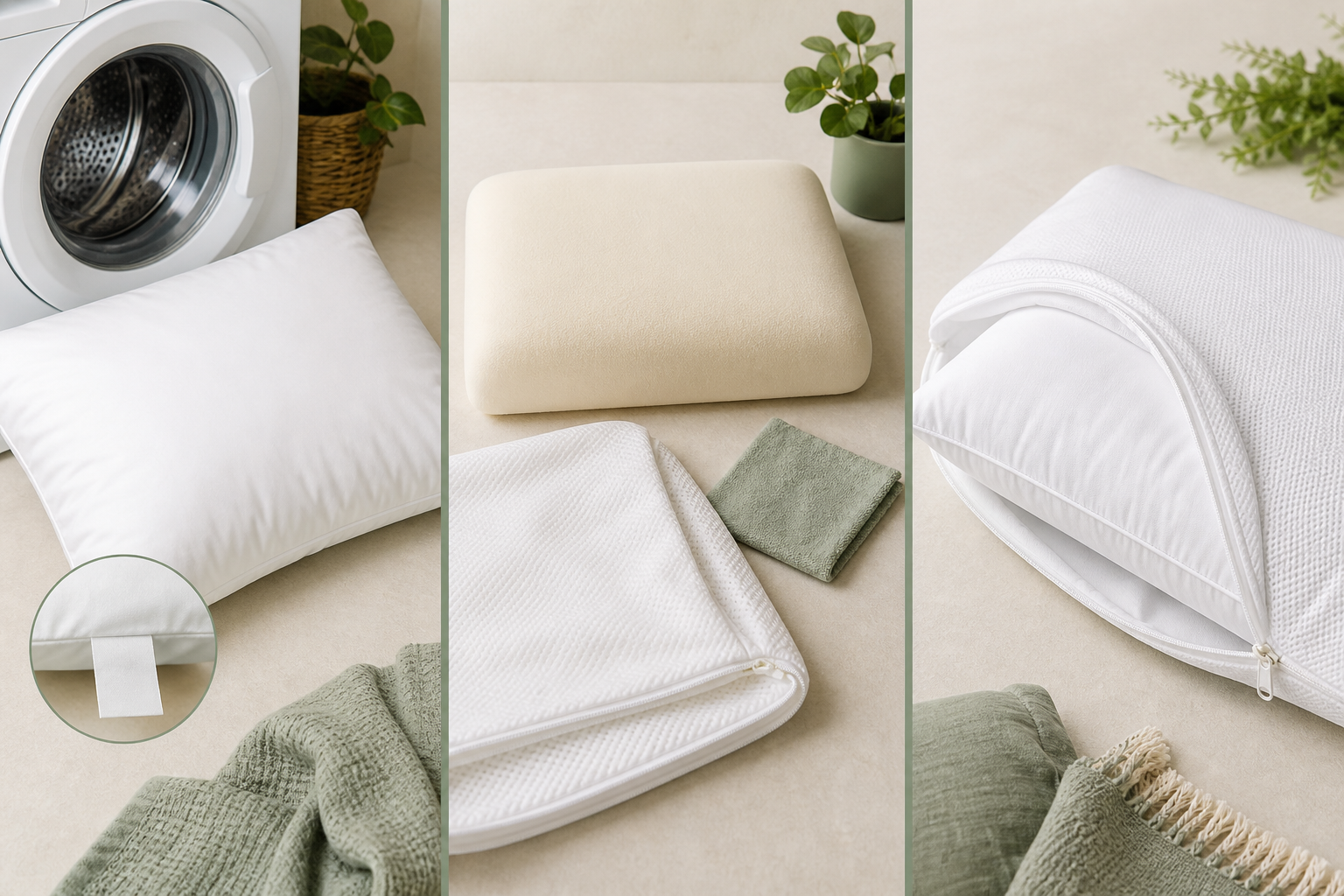
Start by separating every removable layer and reading each label. Pretreat only with a product permitted for that textile, following its dose and contact time. Never assume that a whitening recipe suitable for a cotton cover is safe for foam, latex, down, or a waterproof membrane.
For example, Coop publishes cold delicate-cycle instructions for its Original inner pillow and says it may require several low-heat dryer cycles; the fill must be completely dry. Tempur-Pedic gives the opposite instruction for TEMPUR material: wash the removable cover in cold water, but do not wash or submerge the foam insert. These two real products show why generic 'put the pillow in the washer' advice is unsafe.
- Wash only the components the manufacturer identifies as washable
- Use the stated water temperature and cycle
- Avoid chlorine bleach or fabric softener when the label prohibits them
- Dry the core completely, including the center
- Do not cover a pillow again while any layer is damp
Add a washable barrier before stains reach the core
Compare fabric, liquid resistance, closure, size, and drying instructions before choosing a protector.
How to keep pillows from turning yellow
Prevention means reducing transfer and giving moisture a route to escape. Use a correctly sized, washable protector beneath the pillowcase; wash both on their own schedules; let hair and skincare dry before bed; and air the pillow when it feels humid. A waterproof membrane may improve liquid resistance but can feel different from a lightweight woven encasement, so choose the barrier for the actual exposure.
A practical routine is to keep two protectors so one can be washed and fully dried without leaving the pillow uncovered. If you perspire heavily, inspect the protector more often instead of waiting for the outer pillowcase to look dirty. A protector reduces routine soiling, but it cannot fix high room humidity or a pillow that was put away damp.
Three protector examples for different priorities
SureGuard is the example for shoppers prioritizing a waterproof zippered barrier; its official page describes a cotton-terry surface over a waterproof layer. Protect-A-Bed AllerZip is another full encasement with a polyurethane laminate and manufacturer care instructions. Mission: Allergy instead emphasizes a lightweight microfiber allergen barrier with a published mean pore size and zipper flaps, not a waterproof membrane.
These examples are not ranked from hands-on testing. Compare material, closure, pillow dimensions, washing limits, and current marketplace availability. A protector that compresses the pillow or never dries fully is a poor fit even if its barrier specification looks strong.
When yellowing means it is time to replace the pillow
Replace rather than repeatedly whiten when the pillow has persistent odor, damaged or clumped fill, unrecoverable loft, internal staining that cannot be treated under the care instructions, or visible mold. Also replace it when cleaning would require soaking a core that its manufacturer says must stay dry.
If the pillow is structurally sound, dry, odor-free, and label-safe to clean, discoloration may be mostly cosmetic. Set a realistic endpoint: one careful, label-compliant cleaning attempt is useful; escalating to incompatible chemicals or excessive heat to chase perfect whiteness can damage the pillow more than the original stain.
Frequently asked questions
How do I get rid of yellow stains on my pillow?
Separate removable layers, read every care label, pretreat only with a compatible product, and wash and dry exactly as directed. Do not soak solid foam or latex unless the manufacturer explicitly permits it.
How do I keep pillows from turning yellow?
Use a washable protector under the pillowcase, let damp hair and skincare dry before bed, wash the outer layers regularly, and make sure every layer dries fully before the bed is remade.
Is it okay to sleep on a yellow pillow?
A dry cosmetic stain alone does not establish that a pillow is unsafe. Stop using it while investigating if it is damp, persistently musty, visibly moldy, structurally damaged, or impossible to clean under its care instructions.
Why is one side of the bed more yellow?
People differ in perspiration, skin and hair products, drooling, sleep position, and whether they go to bed with damp hair. The pattern does not diagnose a health condition.
Sources
About the editorial team
The Pillow Advisor checks product specifications, care instructions and reliable expert sources. We do not invent hands-on testing or medical claims.